
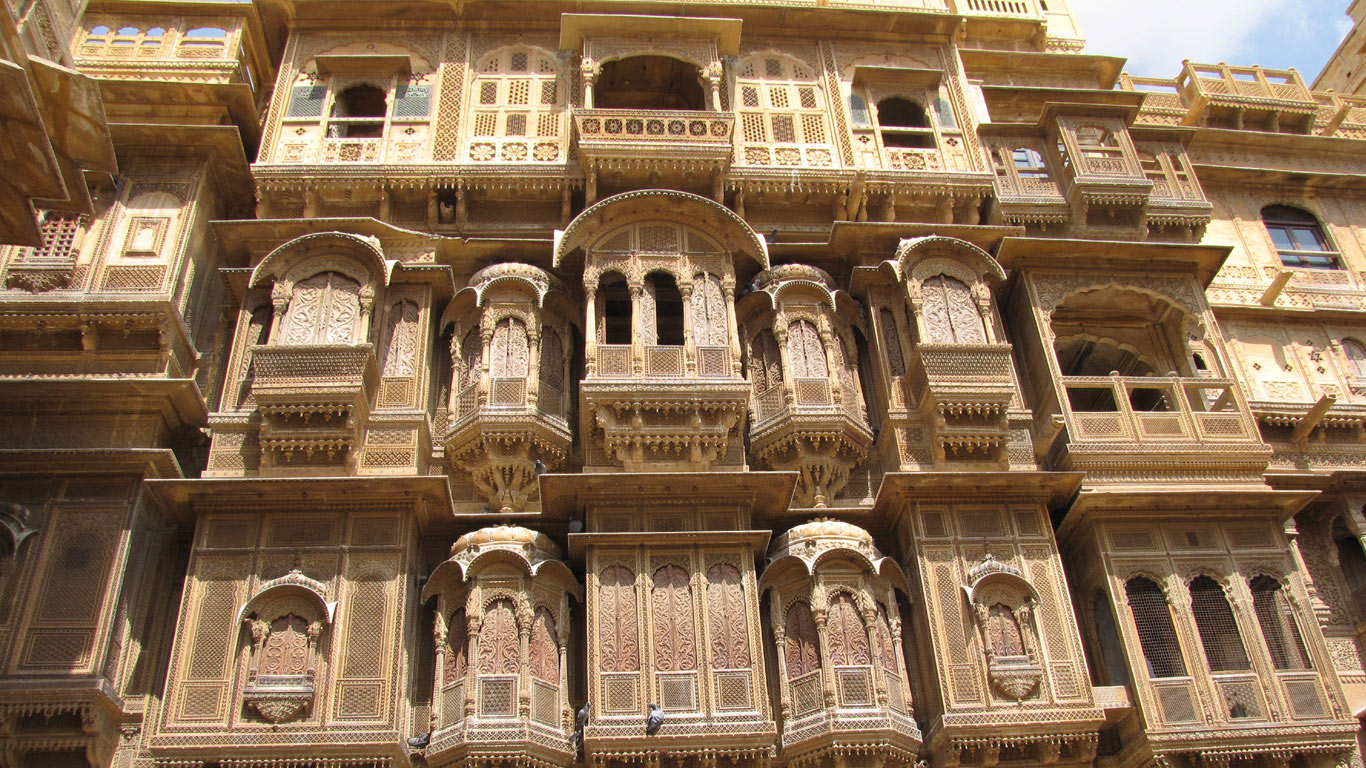
Read the streetscape, not just the famous facade
Jaisalmer’s old city is known for honey-coloured sandstone buildings and narrow lanes. A haveli was a substantial residence associated with a household, and its facade could communicate status, taste and craft. The most rewarding way to explore is not to race from one photo stop to another, but to notice how windows, screens, balconies and entrances fit into a dense streetscape.
The Fort is a living place as well as a historic landmark. Residents use its streets, doorways and shared spaces every day. Keep entrances clear, speak quietly in residential lanes, and remember that an attractive doorway does not automatically mean the building or courtyard is open to the public.
A short walk focused on exterior details is different from a visit to a ticketed heritage interior or a shop inside a historic building. Confirm access, visiting arrangements and any applicable fee before travelling specifically to enter a site.
- Look for carved stonework, shade, windows and balconies rather than photographing only the whole building.
- Give residents, worshippers, shopkeepers and other visitors room to move through narrow streets.
- Treat an exterior view, an open shop and a public heritage interior as different kinds of access.
Patwon Ki Haveli: a cluster of ornate residences
Patwon Ki Haveli is one of Jaisalmer’s best-known architectural landmarks. Official destination guidance describes a cluster of five havelis, noted for elaborate carving and detailed sandstone facades. The complex is a useful place to understand how related residences can read as one continuous architectural composition.
When viewing the facade, step back far enough to see the rhythm of openings and projecting forms, then look more closely at the stonework. Details can be easier to appreciate from a respectful distance than from a doorway or congested spot directly beneath the building. Follow posted rules if you enter a visitor area.
Do not assume every room or part of the complex is accessible on the day you arrive. Confirm current access, admission charges and photography rules through a current official or on-site source.
Nathmal Ki Haveli: notice the details
Nathmal Ki Haveli is often discussed for its construction story and decorative detail. Rajasthan Tourism describes two architect brothers working from opposite sides, an account that encourages visitors to look closely rather than expect every detail to mirror perfectly. Use official interpretation for the history presented at the site.
The building also illustrates how a large residence can bring together public-facing ornament and spaces shaped by daily life. Look at the facade as a crafted surface, but do not assume that every portion is a museum or that the whole interior is available for unrestricted viewing.
Opening arrangements, shop access, entry charges and photography permissions can change. Check them close to your visit, particularly if a specific interior is the main reason for going.
Salim Singh Ki Haveli and the old city today
Salim Singh Ki Haveli is another distinctive landmark in Jaisalmer’s architectural story. Official visitor guidance describes a building whose history remains connected to its present-day surroundings, with parts in use and markets and craft sellers nearby. Heritage here is not limited to a museum setting.
Observe the outline of the upper facade, then compare its appearance with the more repetitive patterns of other havelis. Differences in openings, roofline and carved features make an architecture walk more interesting than treating every sandstone building as interchangeable.
Because parts of the building and nearby lanes remain active, follow site instructions. Do not enter areas marked private, photograph people or workspaces without permission, or block routes used by residents and visitors.
A simple checklist for sandstone architecture
You do not need to be an architect to enjoy these buildings. Start with the shape of the facade, then look at individual details: the projection of a balcony, the depth of a window recess, a carved screen or the way a doorway is framed. Light and shadow can change how these features appear, so a slower look often reveals more than repeated photographs.
Compare buildings by asking questions rather than declaring one universally best. How does a screen soften sunlight? How does a projecting window change the line of a wall? Which patterns repeat, and which seem specific to one house? This approach helps you notice craft without inventing a story about a particular artisan or household.
If a guide is part of your plan, ask the hotel to confirm current availability, language and proposed route for your date. Do not assume every guide covers the same interiors or that every route includes entry to each landmark.
- Stone screens and pierced patterns.
- Projecting windows, balconies and jharokhas.
- Carved lintels, brackets, borders and doorway details.
- How buildings meet the street and how people use those spaces today.
Plan a heritage walk with care
Begin with the Jaisalmer Fort guide for the wider setting, or use the two-day itinerary to consider how much time to leave for the Fort and old city. These are planning aids rather than guaranteed schedules; confirm current access and guide arrangements before you commit.
Wear footwear suited to historic streets, carry water appropriate to the weather and keep your route flexible. The lanes can be narrow and uneven, and cars cannot enter every part of the Fort. If you have mobility requirements, ask about the actual route and surfaces rather than assuming it is step-free.
For date-specific questions about a possible heritage walk, guide availability, languages, access or fees, send the hotel an enquiry. That message is a request for current information, not a confirmed tour booking.
Sources and further reading
Use official references for broad destination guidance. Re-check time-sensitive transport, access and weather details close to your travel date.
- Rajasthan Tourism — Jaisalmer destination guide — Official destination overview of the Fort, havelis and heritage.
- Incredible India — Patwon Ki Haveli — Official visitor guidance for the cluster of havelis.
- Incredible India — Nathmal Ki Haveli — Official architectural and visitor information.
- Incredible India — Salim Singh Ki Haveli — Official background on the haveli and old-city setting.